About Bulgaria
Bulgaria lies in the south-east of Europe and is home to an enviable Mediterranean climate which shifts more towards continental as you move toward the interior. Home to some of the oldest cities in all of Europe, the country is remarkable with some beautifully well-preserved towns and historic settlements for you to take in on your travels.
Bulgaria has a border with Romania which is marked by the Danube and a coastline upon the Black Sea. On the west it is bordered by Serbia and Montenegro, and on the south by Greece, so as you can imagine the country is home to some of the most beautiful scenery in the world and complemented by weather conditions to match. The coast of Bulgaria is home to the largest area of low land- a contrast to the west and south which see a mountainous country that rises to over 7000 feet. As you increase in altitude you increase in temperature extremes along with higher levels of precipitation, so in the low lands, you see much more moderate rainfall and more mild conditions. Summers do have a tendency to get quite hot, and winters fairly cold.
Coastal Region
Along the coast is where you will find conditions that are most reminiscent of parts of the Mediterranean, and it is here that you will find a few coastal resorts scattered which are perfect for summer getaways. The town of Varna lies upon the Black Sea coast and experiences warmer winters than any other part of the country, however when the cold air blows down from the Russian Federation you will be hit with bitterly cold conditions and during this time it is not uncommon for the Danube and other smaller lakes and rivers to freeze over completely.
The winter months in Varna, on average see daily lows of -1 ºC and highs of 6 ºC. Rainfall is at its peak in December, with 63mm of precipitation recorded on average, but drops dramatically in January when average precipitation across the month is only 28 mm across about 8 days of the month. Rainfall stays fairly minimal until June where it again picks up to an average of 64mm across the month. With the introduction of summer comes daily highs of into the high 20's and often into the 30's, complete with about 10 to 11 hours of uninterrupted sunlight.
One of the most popular tourist getaways in Bulgaria is the town of Burgas and the popular resort town of Sunny Beach. Home to beautiful golden sandy beaches, warm ocean temperatures and hours of sunlight in the summer months, this part of the country is a favourite holiday destination for both locals and international travellers alike.
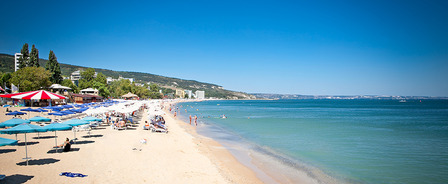
Varna beach, Bulgaria.
Inland Region
As you move westward you will gradually reach the higher lying parts of the country, including Bulgaria's beautiful and historic capital, Sofia, lies in the far west. Sofia sits in the Sofia Valley, surrounded on all four sides by mountains. Sofia's climate is continental- meaning it experiences high-temperature amplitudes across the year. January, on average, is the coldest month of the year, while August sees Sofia experience highs in excess of 30 ºC for days on end. Winter in Sofia really begins around November, when temperatures drop down to 1.2 ºC in the night times and the daily maximum only reaches 9.6 ºC. Winter is one of the driest times of the year in Sofia, with January actually recording the lowest precipitation for the year, at only 28mm, and similar conditions in February with 31 mm of rain. While snow can be expected in many areas across the country, due to Sofia's higher elevation it is possible to see snow cover well into spring, and you can make the most of the winter snowfall by engaging in the variety of winter sports that the region offers.
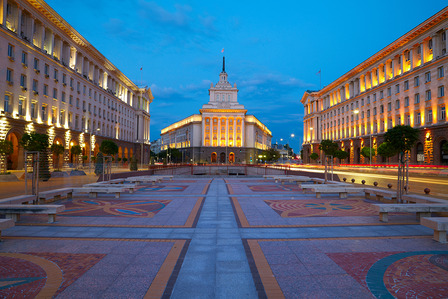
The city centre of Sofia, capital of Bulgaria.
Rainfall picks up in the summertime, by May the city is being washed with 73mm of rain which picks up to 75mm by June and stays above 50mm throughout the rest of the season. While average precipitation is at its highest in late spring and early summer, average days of rain is pretty consistent across the year, with each month normally seeing about 10 days of rain, other than May and June which see 14 and 13 respectively. The mercury begins to rise by late May and June brings daily highs of 26.7 ºC before peaking at daily highs of 30 ºC in August. Night time brings cooler temperatures of 12ºC to 13 ºC, so this is a welcome relief from the day's heats. Sofia is one of the oldest cities in Europe, possible to be traced back over 7000 years, so as a result you can wander the well-preserved walls and take in the architecture that dates back before 7th century BC. Along with being home to some of the oldest cities in Europe, Bulgaria also plays host to about 540 different rivers- most of which are fairly short and very shallow in parts- making many of them perfect for cooling down in on a summer's day. Along with a dense network of rivers Bulgaria houses about 50 spa towns and resorts which is a popular getaway in the warmer months.
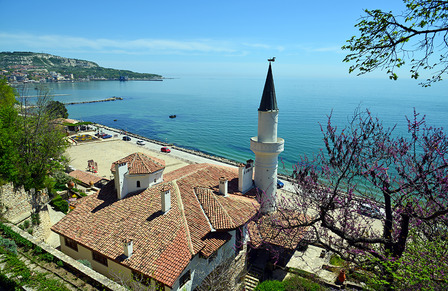
Residence of the Romanian queen by the black sea in Balchik, Bulgaria.