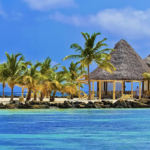
Aruba is a small, tropical
island that basks in glorious heat all year round. The perpetual summer is complemented
by a short rainy season. The island is part of the Lesser Antilles, the
smaller, south-western islands of the Antilles Islands of the Caribbean.
The Antilles are strung out in a languid curve from the
northeast coast of Venezuela,
up towards Florida.
Cuba, the largest of the
Antilles, curls down again, pointing a peninsula at Cancun on the north-eastern
tip of Mexico.
The islands wrap around the east and north Caribbean Sea, enclosing it and dividing
it from the North Atlantic Ocean. The islands
make up to the greater portion of the West Indies.
The Bahamas, also part of
the West Indies, lying to the north of the Antilles and geographically part of
the string of islands, are not considered part of the Antilles.
The Lesser Antilles are autonomous regions within the
Kingdom of the Netherlands.
They are part of a volcanic arc of islands and are considered geologically
young due to their make-up of volcanic rock and coral. Aruba is one of the
Leeward Antilles that lie in the southwest nearest the coast of South America.
The day time temperature of Aruba and of the rest of the Lesser Antilles does not venture far from the average of
31°C. From May till October the day time average stays between 31.1°C and
31.7°C. Then in November it plummets to, shock horror, 30.6°C, and dwindles in January
and February to a mere 29.4°C. This wild meteorological mayhem has led herds of
tourists to consider pulling their bikini straps back up, despite the risk of
tan lines. Although Aruba is generally very
humid all year, the heat does not usually become unbearable due to a reliable
wind coming from the east. Night times remain hot and sticky around the mid 20s
so outdoor revelry can continue round the clock; air-conditioned accommodation
is preferable if you plan to sleep.
The sea is at its “coolest” from January to April, seeing an
undeniably balmy average of 26°C. It heats up throughout the summer months and
reaches its peak in October at 29°C.
The wind is at its strongest from January to March and
provides water sport enthusiasts with perfect wind-surfing and sailing
conditions. The wind is predictable because the almost uniformly flat terrain
of Aruba allows the same wind to build up
everyday. This wind is able to whisk clouds efficiently over the island, not
giving them the chance to develop into rain clouds. Because of this, the sea is
usually placid, in the south, presenting a clear sea for scuba diving and
snorkelling. Another effect is that Aruba, and the other Leeward Islands,
receive almost half the rain of the Windward Islands.
The island’s average yearly rainfall is around fifty centimetres, most of which
falls during the rainy season which lasts from October to December. Rain is
usually short-lived and followed by brilliant sunshine; year round Aruba rarely sees less than eight hours of sunshine and
clear skies a day.
While rains can be heavy they rarely whip up into violent
storms. The island is usually treated to about one thunderstorm per summer
month. Aruba lies just out of the usual path
of hurricanes but in 2007, residents were terrorised by hurricane Felix which
passed just north of the island. Almost no damage was done but the island
experienced winds beyond tropical storm force and it was considered a very
close call. That’s about the most excitement Aruba
has ever seen in terms of weather. While there is regional variation, each
region has quite predictable weather. The island’s complete lack of adventurous
climatic spirit is celebrated by locals has turned the island into a Mecca for tourists. As
such there is never a truly bad time to visit Aruba
in terms of the weather, but there is also never a perfect time to visit in
terms of crowds.
Aruba is classed as having a tropical maritime climate,
which can be attributed to its position just a skip away from the equator, in
the Caribbean Sea and its proximity to
surrounding, protective land. Aruba’s light winds and lower levels of rain in
comparison to the other Antilles islands are
owed to its flat topography. There is some regional variation in climatic
conditions from place to place on Aruba. The
north has an unsettled sea as this is the windward side of the island. This is
in great contrast to the southern and west coasts which offer those wanting to
explore the reef clear visibility down to one-hundred feet. The interior of the
island is quite arid with sand dunes and desert-like plains, as well as desert
vegetation such as cacti, while the coastal regions are dotted with palms. This
is atypical of tropical, volcanic islands, which are usually densely vegetated,
and is mainly due to the constant wind and low rainfall.
back to top